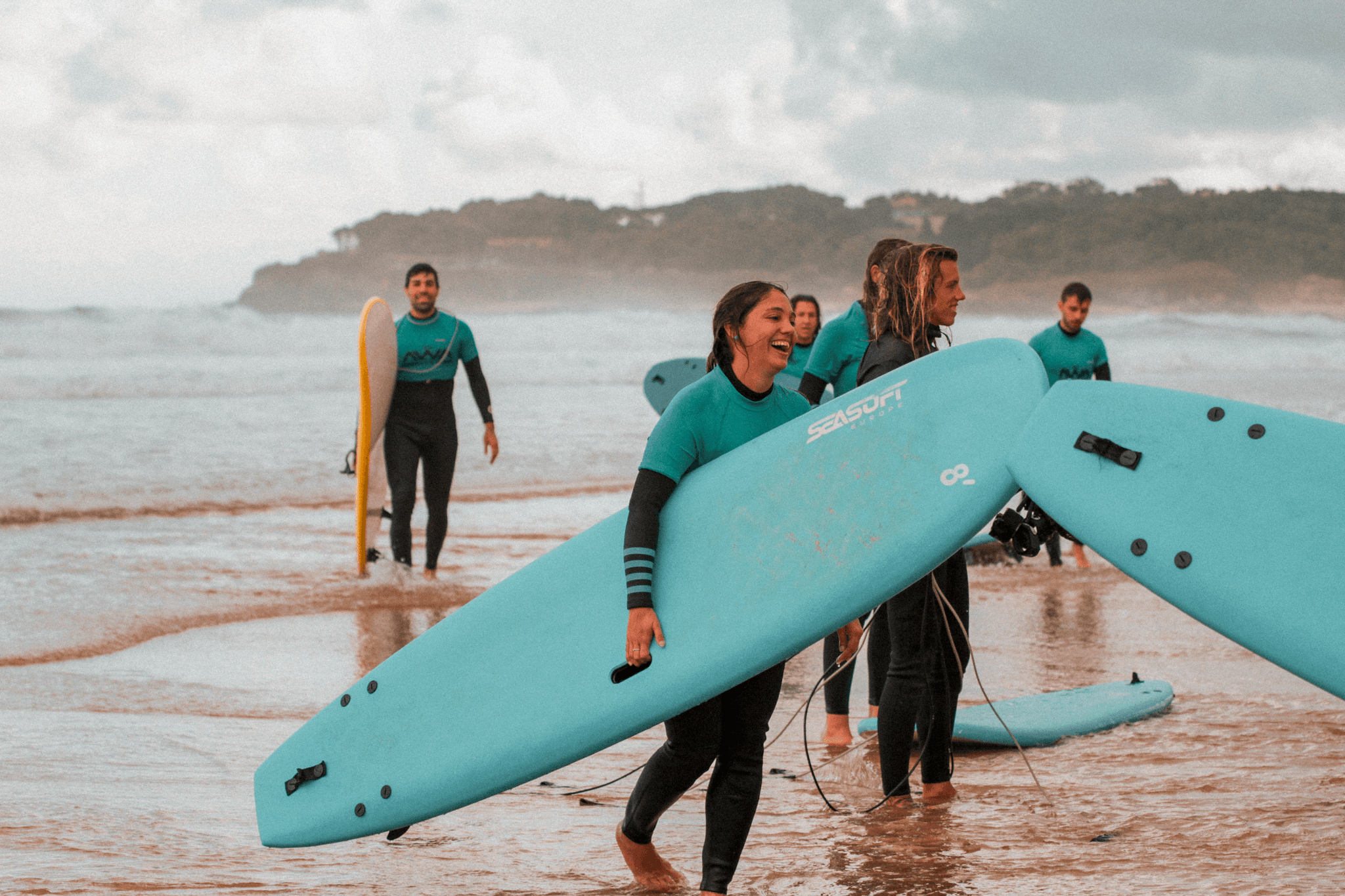
How to Choose the Right Wetsuit: From Your First to Your Travel Kit
How to choose the right surf wetsuit: thickness depends on the water temperature at your destination. Above 24°C a rashguard is enough, between 17 and 23°C you'll want a 3/2, below 17°C go for a 4/3 or thicker. Fit matters just as much as thickness.
Quick info
Surfhouse
May 15, 2026
11 min read
Choosing the right wetsuit comes down to three variables: water temperature at your destination, session length, and how easily you get cold. Thickness is the main factor: above 24°C you can surf in a lycra or a 2mm suit, between 18 and 23°C you'll want a 3/2, below 17°C a 4/3 or thicker. Fit matters just as much as thickness — a wetsuit that doesn't sit right loses most of its thermal effectiveness.
How to choose the right surf wetsuit: from your first suit to the perfect travel kit
A wetsuit is the second most important piece of gear you'll buy after your board — and the one most people get wrong. Too thin to save money, too thick out of caution, or the wrong size because nobody told you what to look for in the changing room.
The result is the same in all three cases: shorter sessions, more fatigue in the water, and a wetsuit that ends up buried at the back of a cupboard after a few trips.
This guide covers everything you need to make the right call — from buying your very first suit to figuring out what to pack for every Surfhouse.world destination. No unnecessary jargon, just the parameters that actually matter.
Why a wetsuit is technical gear, not just an accessory
Before getting into the details, one thing is worth stating clearly: a wetsuit is not optional, and it's not just about staying warm. It protects you from board and reef abrasions, shields your skin from UV during long sessions, and keeps your core temperature stable even in water that feels perfectly comfortable at first.
A surfer who loses heat in the water also loses coordination, reaction time, and focus. Sessions get shorter, performance drops, and the risk of injury goes up.Having the right wetsuit isn't a luxury — it's a condition for surfing well.
The good news is that choosing correctly is straightforward, once you understand the three parameters that drive the decision.
The key parameter: water temperature
Everything starts here. The water temperature at your destination determines the thickness you need — not the air temperature, not the season in general terms: the water temperature.
Here's a practical breakdown to guide you:
Above 24°C: lycra or rash guard, or a 1–2mm suit. The goal here isn't warmth but sun and abrasion protection. Destinations: Sri Lanka (Ahangama, Mirissa), Indonesia (Canggu, Mentawai), Nicaragua (Popoyo), Brazil (Marau), Mexico.
Between 20 and 24°C: a 2/2 or short-arm 3/2. Enough for most sessions in warm temperate water. Destinations: Canary Islands in summer (Las Palmas, Adeje), Morocco in summer, Conil de la Frontera from May to September.
Between 17 and 20°C: a full 3/2. The most common range for European Atlantic destinations in spring and autumn. Destinations: Portugal (Costa da Caparica, Aljezur, Figueira da Foz) from April to October, Canary Islands in winter, Morocco in autumn.
Between 14 and 17°C: a full 4/3. Essential for Atlantic destinations in winter and northern European coastlines. Destinations: Portugal in winter, France (Vieux Boucau) from October to April, northern Spain (Somo) in winter.
Below 14°C: a 5/4 or thicker, with booties and often gloves and a hood. Nordic destinations or particularly harsh winters.
A note on cold sensitivity: these ranges are guidelines. If you run cold, go up half a thickness from the chart. If you run warm, you can step down. Experience will tell you where you land — when in doubt, start on the warmer side.
Cuts: what sets one wetsuit style apart from another
Thickness tells you how much warmth a suit provides. The cut tells you how that protection is distributed across your body — and how freely you can move.
Full suit / Steamer: the most common and versatile option. Full coverage, available in all thicknesses from 2mm to 6mm. This is what you'll reach for at the vast majority of Atlantic destinations. If you're just starting out, this is your reference cut.
Shorty: short arms and short legs, 1–2mm thickness. Ideal for water between 20 and 24°C when you want sun and abrasion protection without the coverage of a full suit. Works well in the Canary Islands in summer, Morocco from May to September, and tropical destinations where the water feels cool relative to the air.
Spring suit: long legs with short arms, or long arms with short legs. A hybrid between a full suit and a shorty. Useful during seasonal transitions when your upper and lower body need different levels of coverage. Less versatile than either of the other two for surf trips — it takes up space and covers a narrow temperature window.
Lycra and rash guard: these are not wetsuits in the technical sense and provide no thermal insulation. They exist purely for UV protection and to prevent abrasions. Essential in the tropics, where sun is the main concern and water temperatures sit above 26–27°C.
What to pack for a trip: the practical rule is to bring one suit dialled in for the destination, not two to cover all scenarios. An extra wetsuit in your surf bag means dead weight and wasted space. Check the average water temperature for your destination during your travel window, choose the right thickness, and don't overthink it.
Sizing: the most underestimated factor
A suit that doesn't fit properly loses most of its effectiveness, regardless of neoprene quality.If water is flushing freely between the suit and your skin, the warmth your body generates is constantly being washed away and the suit simply can't hold temperature.
Every brand has its own size chart based on height and weight. These charts are a starting point, not a definitive answer — manufacturers fit differently, and some suits run tight while others run generous. Try before you buy whenever you can.
What to check in the changing room: The shoulders shouldn't pull when you raise your arms into a paddle position — if you feel significant resistance, the suit is too small or the cut doesn't suit your build. The chest panel should lie flush against your skin with no air pockets. Wrist and ankle seals should close without leaving gaps that let water flood in. The suit should feel snug but never painful — if your circulation feels restricted after five minutes, size up.
If you're buying online without being able to try it on: read reviews that specifically mention fit for that model, compare your measurements against the brand's size chart, and if you're between two sizes, go larger if you'll be surfing 17–20°C water, smaller if the water is colder and a close seal is critical.
Closure systems: back zip, chest zip, or zip-free
It's a detail that affects both ease of use and thermal performance.
Back zip: the most common and the easiest to get into on your own. The zipper runs down the back and closes with a pull cord. It lets in more water than other systems, but it's the most practical choice for beginners and for anyone who doesn't want to wrestle with their gear.
Chest zip: the zipper sits across the chest, nearly horizontal. Harder to get into, but significantly more watertight than a back zip — less water flushes through and heat is retained better. Recommended for water below 17°C or for long sessions in cold conditions.
Zip-free: the neoprene is elastic enough to pull on without any zipper at all. Maximum waterproofing and flexibility, minimum convenience when suiting up. Typically found in high-end suits aimed at experienced surfers. Not the right choice for a first purchase.
For beginners: back zip, no question. Easy to put on and take off solo, available in all thicknesses, and it performs well in the vast majority of Atlantic conditions.
From water temperature to the right wetsuit: some real-world examples
Knowing that "a 3/2 works between 17 and 20°C" is useful in theory. But when you're actually planning a surf trip, the real question is different: how cold is the water at that specific destination, at that specific time of year?
The answer always depends on two variables together: where you're going and when.
The same destination can call for different thicknesses depending on the season, and two geographically close spots can have very different water temperatures because of ocean currents.
A few concrete examples to show how this plays out in practice.
Atlantic Morocco around Tamraght and Aourir in autumn sits between 20 and 22°C — a full 3/2 covers everything comfortably, with room for those long early-morning sessions. The same stretch of coast in the middle of winter drops toward 17–18°C: a 3/2 still holds, but anyone who runs cold will be much happier in a light 4/3.
Atlantic Portugal is colder than it looks on paper. Costa da Caparica and Aljezur in September sit around 18–19°C — a 3/2 does the job. From November onwards the water drops toward 15–16°C and a 4/3 becomes necessary, not optional.
The Canary Islands feel warm because the air temperature is. But Lanzarote and Fuerteventura in winter have water between 19 and 21°C — a 3/2 is the minimum, a 4/3 is more comfortable for sessions of two hours or more. In summer the same islands climb toward 22–23°C and a 2/2 is enough.
At tropical latitudes the logic flips entirely. In Sri Lanka at Ahangama and Mirissa between December and March, the water is 27–28°C — a lycra or a 1–2mm suit is all you need, and its job is to protect you from the sun and the reef, not the cold.
Jeffrey's Bay in South Africa is a case of its own: the Indian Ocean in that stretch is far colder than the latitude would suggest. Even in the southern hemisphere summer the water hovers between 17 and 20°C. A 3/2 is the minimum; anyone who tends to get cold will reach for a 4/3 without regrets.
The practical rule: before you leave, check the average water temperature for your destination and specific month on Surf-Forecast or Windguru. Use that as your baseline, go up half a thickness if you know you run cold, and don't pack two different suits to cover your bases — pick the right one and leave it at that.
Care and maintenance: making your wetsuit last
A quality wetsuit lasts for years if you look after it. With prices ranging from €150 to €400 depending on brand and spec, it's worth the effort.
After every session, rinse it thoroughly with fresh water, inside and out. Salt and sand break down neoprene and damage the seams. Don't wring it out or twist it — fold it in half and let it dry in the shade, never in direct sunlight, which degrades neoprene irreversibly. Don't hang your wetsuit by the shoulders on a standard hanger: the weight of wet neoprene will distort the seams over time. Use a wide hanger or fold it over a horizontal rail.
FAQ
Other articles
Winter Surfing: the Best Destinations (and How to Pick the Right One)
The best winter surf destinations: Canary Islands (consistent waves, short flight), Sri Lanka (December–March, all levels), Indonesia (Mentawai and Bali, advanced surfers), South Africa (Jeffrey's Bay, iconic breaks), and Nicaragua (Popoyo, uncrowded lineups)
Autumn Surfing: Where to Go (and Why It's the Best Season of All)
Autumn surfing at its finest: Morocco, Portugal, the Canaries, and Northern Spain peak between September and November. Fewer crowds, better prices, and Atlantic swells that leave summer in the dust.
Surf This Summer: The Beginner's Guide to Getting Started (and Getting It Right)
Summer surf for beginners: top destinations include the Canaries (Las Palmas, Lajares, Adeje), Northern Portugal (Figueira da Foz, Estela Porto), France (Vieux Boucau), and Australia (Arrawarra NSW, austral winter).
DIY surf trip: the practical guide to planning it efficiently
A DIY surf trip comes together in five steps: pick the right destination for the season and your level, book your flight 6–10 weeks out, find a verified surfhouse close to the breaks, sort your gear before you leave, and read the forecasts on Windguru or Surf-Forecast