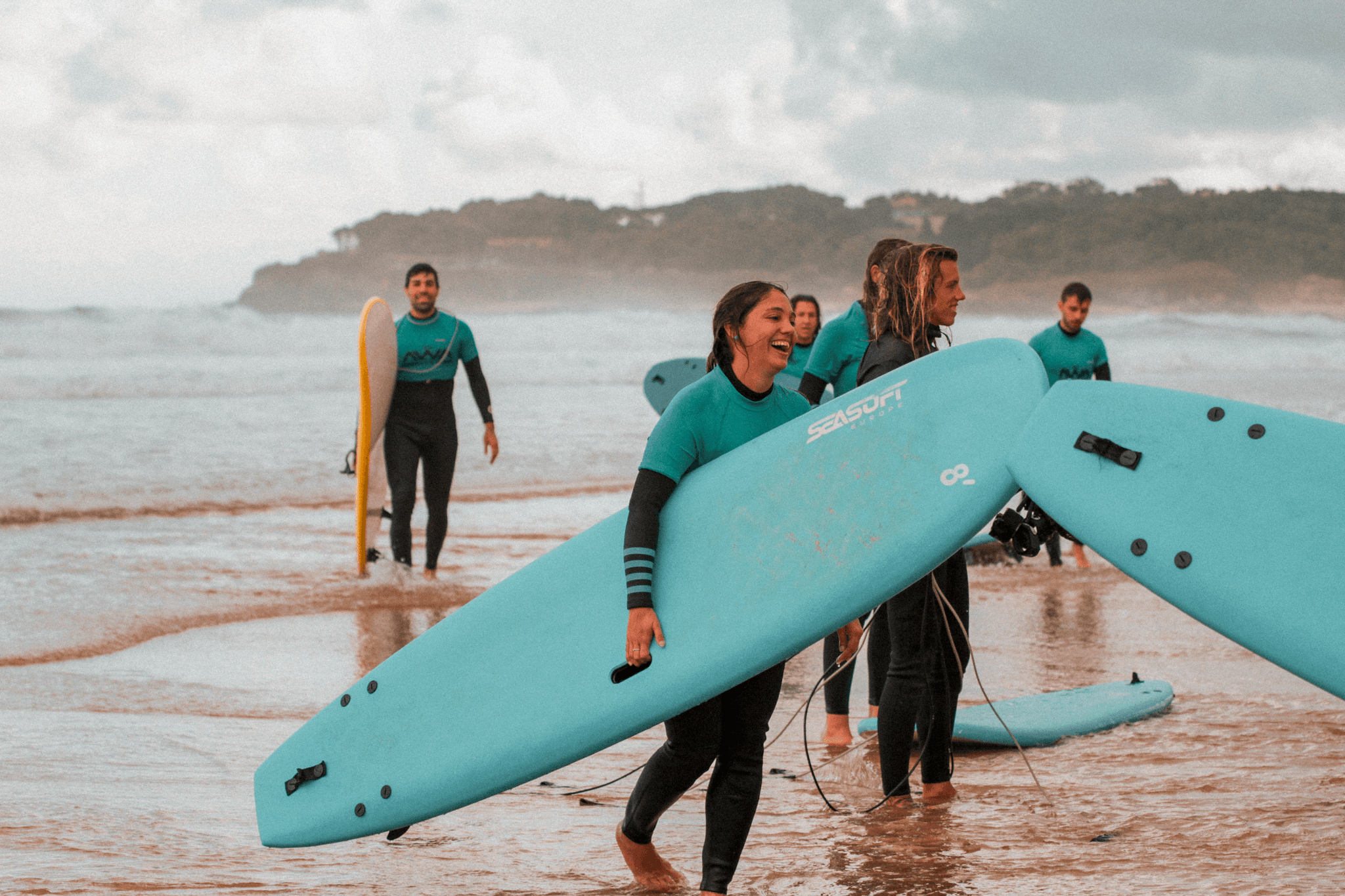
The best destinations to learn to surf in summer are the Canary Islands (waves year-round, guaranteed), Northern Portugal (Figueira da Foz, Estela Porto), France (Vieux Boucau), and Australia (Arrawarra NSW, in the heart of the southern winter with ideal beginner conditions). All of them have surfhouses on Surfhouse.world with lesson packages and surf camp formats. If you're a complete beginner looking for an organised group experience with Italian-speaking guides, check out SurfWeek too.
Summer surfing: the guide for beginners who want to get it right
Every year, thousands of people step onto a surfboard for the first time in summer. Some stumble into it on holiday — a crowded beach, a last-minute instructor, no real plan. Others show up with everything sorted: destination chosen, surfhouse booked, lessons already lined up.
The results, as you'd expect, are worlds apart.
Learning to surf takes the right conditions: small, consistent waves, a skilled instructor, and a place that knows the area well enough to take you to the right spot every single day. Without those elements, the learning curve stretches out and frustration creeps in.
Summer isn't the season for big waves — not if you're an experienced surfer chasing size. But it is the season with the most beginner-friendly conditions: smaller swells, warm water, long days. And with the right setup, it can be the experience that changes how you spend your holidays for years to come.
Why summer is the right time to start
Anyone who's been surfing for years knows that the Atlantic summer isn't the season for the best waves. High pressure systems flatten the swells, the beaches fill up, and conditions can be downright frustrating if you're looking for action.
For a beginner, though, the equation flips completely.
Small, consistent waves between 0.5 and 1.5 metres are exactly what you need when you're just starting out. They give you the time to pop up, find your balance, and read the moment — without being thrown around by forces you're not yet equipped to handle. A small, well-shaped wave teaches you far more than a big one that holds you underwater before you even know what happened.
Add warm water, long days, and the freedom to surf twice a day without the cold cutting your sessions short. For a beginner, summer makes a lot more sense than most experienced surfers are willing to admit.
What to look for in a beginner-friendly surfhouse
Not all surfhouses are built the same, and not all of them are suited to first-timers. When you're searching for the right place for your first surf trip, a few key features make a real, tangible difference.
Lessons included or available on-site. A certified instructor with you from day one changes everything — not just for safety, but for progress. Without proper technical feedback, beginners tend to lock in bad habits that are genuinely hard to unlearn.
Local spot knowledge. The best surfhouses don't just send you to the nearest beach regardless of conditions. They know where to go based on the wind, the swell, and your level. That's the real advantage over going it alone.
A social environment. Learning alongside people at the same level, sharing the same stoke, makes the whole thing lighter. Surfhouses with a surf camp format build that atmosphere naturally — you paddle out together, debrief together, improve together.
Equipment included. Soft-top board, wetsuit, leash — for a beginner, having the right gear without having to buy or rent it separately is essential. Any serious surfhouse includes it in the package.
On Surfhouse.world you'll find only verified properties, with filters for surf level, travel dates, and package type — lessons and surf camp format included.
The best destinations to learn to surf in summer
Canary Islands: waves guaranteed even when the Atlantic goes flat
The Canary Islands are the most reliable choice for anyone wanting to learn in summer. The reason is straightforward: while the North Atlantic quiets down, the islands keep receiving swell from the open ocean with impressive consistency. You'll never find a completely flat week in the Canaries, not even at the height of summer.
Las Palmas on Gran Canaria has an urban break that works almost every day: a sandy beach right in the heart of the city, well-established surf schools, and surfhouses with quality training packages just a short walk from the water. Lajares on Fuerteventura is an excellent base for anyone who wants variety across the same week — the north of the island packs in accessible beach breaks and an authentic surf scene well away from the mass-tourism crowds. Adeje on Tenerife rounds out the picture with more sheltered spots and particularly manageable conditions for absolute beginners.
What to expect: waves between 0.5 and 1.5 metres on most summer days, water temperature around 22–23°C, air temperature between 24 and 28°C. Direct flights from Italy to all the main islands, with daily services and competitive prices even in peak season.
Find surfhouses with lessons in the Canary Islands on Surfhouse.world
Northern Portugal: Figueira da Foz and Estela Porto, waves with character
Northern Portugal in summer is one of Europe's most underrated destinations for beginners. While the Algarve fills with tourists and the waves ease off down south, the Atlantic coast between Porto and Figueira da Foz holds more consistent swells thanks to its northwest exposure — and the afternoon thermal wind creates interesting conditions at the right times of day.
Estela, near Porto, is a long, forgiving beach break with a sandy bottom — ideal for anyone who wants to rack up back-to-back sessions without worrying about currents or reef. The area has a well-established local surf scene, and surfhouses in the zone run weekly packages with lessons included for all levels.
Figueira da Foz offers a different flavour: one of Portugal's longest beaches, with multiple peaks that mean you can always find a good patch of space, even on the busier days. Summer waves here rarely top a metre and a half — perfect if you're still building your foundations.
What to expect: water around 17–19°C (a 2/2 or 3/2 summer wetsuit is recommended — northern Portugal is cooler than most people imagine), air temperature between 20 and 26°C, direct flights to Porto from Italy at accessible prices. Northern Portugal offers a value-for-money ratio that's hard to beat anywhere in Europe.
Find surfhouses with lessons in Portugal on Surfhouse.world
France: Vieux Boucau, quality without the Hossegor crowds
Vieux Boucau in summer is a smart pick for anyone who wants a quality European surf trip without getting swallowed by the crowds of Hossegor and Biarritz. Just a few kilometres north of the famous Basque spots, this Les Landes town delivers a powerful, well-shaped beach break with an atmosphere that stays genuine even through the peak summer months.
What to expect: waves between 0.5 and 1.5 metres on standard days, water around 20–22°C from June, air temperature between 25 and 30°C. The Les Landes beach break can pack more punch than some of the other destinations on this list — it's not the easiest place for your very first days on a board, but with a solid instructor and a smaller swell running, it's perfectly manageable for beginners.
The main advantage: Vieux Boucau is driveable from Italy in under a day. For anyone who'd rather skip the airport in peak summer, it's one of the few quality surf destinations you can reach by road, with surfhouses offering full weekly packages including lessons and equipment.
Find surfhouses with lessons in Vieux Boucau on Surfhouse.world
Australia: when European summer is the perfect southern winter
This is the angle no competitor uses in a summer article — and it's worth understanding why it works. While Europe is in full summer mode, Australia is in winter: and the southern winter on the New South Wales coast is the best surf season of the year.
Arrawarra, NSW, is a small town on the mid-north coast of New South Wales with a point break that fires reliably between June and August. Waves between 1 and 2 metres, water at 18–20°C (3/2 wetsuit required), and a lineup that never gets overcrowded thanks to its location well off the main tourist trail. The surfhouse at Arrawarra is one of the most authentic setups in the Surfhouse.world network: not a resort, but a proper operational base built for people who are serious about surfing in a genuine, no-frills setting.
Who makes sense for Australia in European summer: anyone with at least 2–3 weeks off, a beginner-to-intermediate level, and a desire for an experience completely off the European surf radar. It's not the cheapest destination given the flight, but it's arguably the one with the highest authenticity-to-wave-quality ratio of any summer option out there.
What to expect: one-stop flight (usually via Dubai, Doha, or Singapore into Sydney), then a transfer up to the mid-north NSW coast. Australian cost of living, which is in a different league from European or North African destinations. An investment that makes sense for anyone who wants to turn their summer into a real adventure.
Find surfhouses with lessons in Australia on Surfhouse.world
The surf camp format: why it works better than going it alone
You could book a flight, find somewhere to stay on a general accommodation site, and hunt down a surf school when you arrive. Plenty of people do. But if you're just starting out, that approach has one real weakness: nobody is optimising your experience.
The surf camp format solves exactly that. A place that combines accommodation, instruction, and daily session management takes the logistics off your plate entirely and puts you in the best possible position to learn. The instructor already knows which spots are working that day. The lesson schedule is built around the tides. The gear is already waiting for you.
The result: 7 days at a good surf camp will take you further than three poorly planned surf holidays ever could.
On Surfhouse.world you'll find surfhouses with verified surf camp packages for every destination.
If you're looking for something even more structured — an Italian-speaking group and a tried-and-tested intensive format — check out SurfWeek: organised surf trips designed for people who want to learn in good company, with both European and international destinations. Two different approaches, one shared goal: surfing.