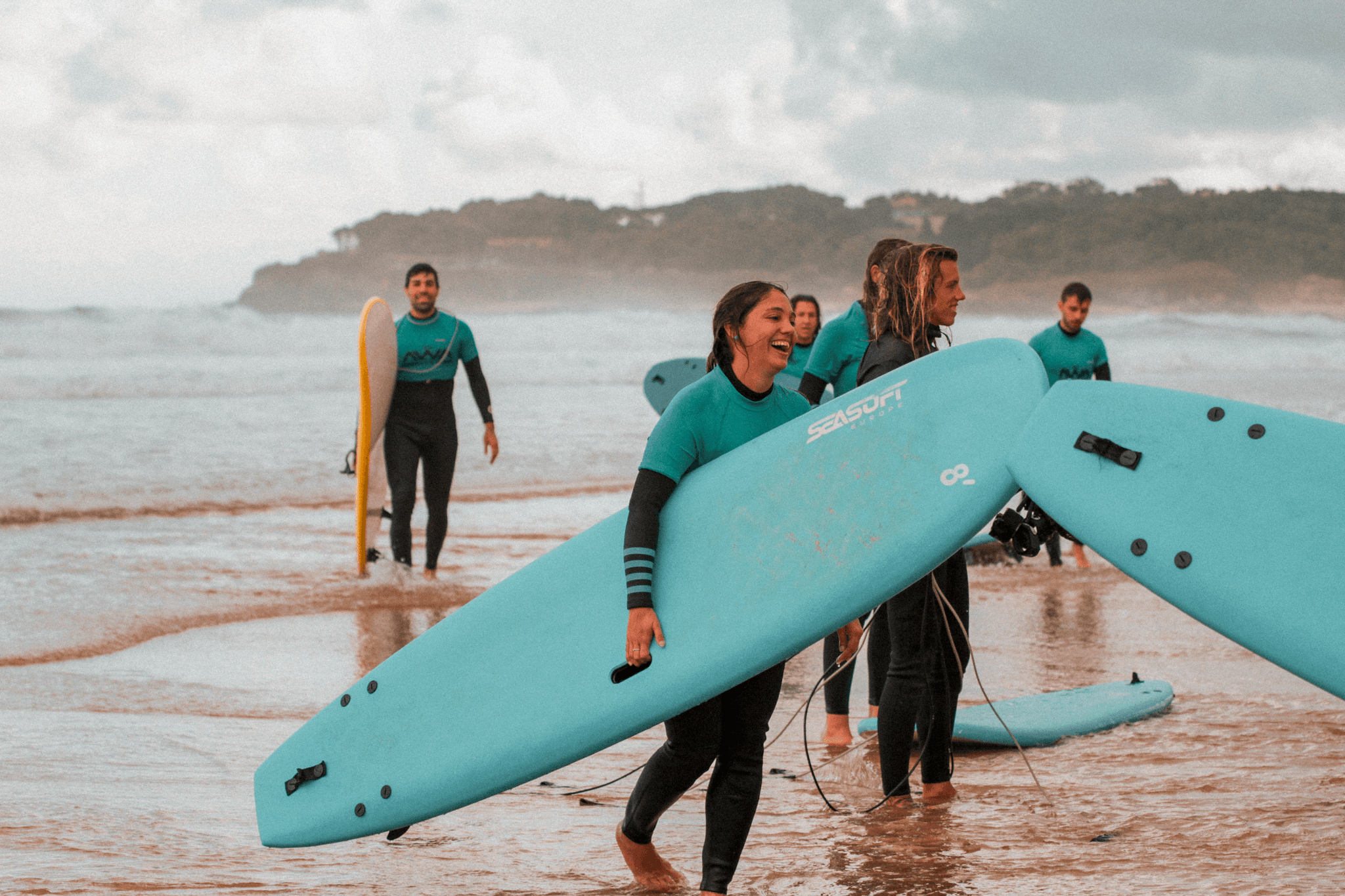
Surf camp vs surfhouse: the differences nobody clearly explains
Surfhouses and surf camps are different formats — neither is better than the other. A surfhouse is an independent base for surfers who already ride, close to the spots and with a built-in surf community. A surf camp offers structure, instructors, and guided progression, even for intermediate and advanced surfers.
Quick info
Surfhouse
May 15, 2026
7 min read
Surf camp vs surfhouse: the differences nobody actually explains
Before getting into what sets a surf camp apart from a surfhouse, there's a more pressing question to answer. One that almost nobody asks out loud, but that's really the one that matters: why would you choose a surfhouse over a regular hostel or guesthouse near the beach?
If you don't have a clear answer to that yet, the surf camp comparison can wait. Let's start here.
Surfhouse vs hostel: what actually changes
From the outside, they can look like the same thing. Beds, shared or private rooms, breakfast included or not, a spot close to the beach. But the experience inside is completely different — and the real distinction comes down to the vibe in the air.
You walk into a hostel near the beach. You find people on holiday, each with their own agenda, and nobody knows where the best spots in the area are. Nobody tells you whether this morning's conditions are worth it or not. Nobody caught that the swell shifted last night. Surfing is one of many things you could do — not the reason the place exists.
You walk into a surfhouse. The morning conversation is already different: tides, wind, which spot is working today with this swell direction. Everyone in that house is there for the same reason you are.
A surfhouse isn't just accommodation with the beach nearby — it's an operational base built entirely around surf, where everything — from the location to the daily schedule, from the early breakfast to the on-site board rental — is designed to make the most of your sessions. Many surfhouses also offer direct support or work with local partners to provide surf lessons and board rental for beginners and beyond.
Here's what concretely sets a surfhouse apart from a generic hostel or guesthouse.
A strategic position relative to the spots. A serious surfhouse isn't just close to the sea — it's within walking distance of the spots that are actually working during your visit. No time lost in transfers, no dependence on a rental car to reach the break.
Gear available on-site. Boards in different volumes and lengths, wetsuits, leashes, wax — all available without having to track down a surf shop or pay tourist-rate rental prices. The best setups also have a dedicated area for rinsing and storing boards.
Local knowledge built in. The staff at a surfhouse knows the local spots better than any app. They know where to go with a north wind, where to go when the swell is small, which spots to avoid when there are dangerous currents. That kind of insight is worth as much as an extra session.
A community with the same goal. Surfhouses naturally breed connection between guests: you paddle out together, debrief sessions, swap notes. It's not organised or forced — it happens because everyone is there for the same reason. If you're travelling solo, this completely transforms the quality of your trip.
Total flexibility. Unlike a structured surf camp, at a surfhouse you run your own schedule. You go out when you want, come back when you want, skip a session when your body needs it. No programme to stick to, no group to keep up with.
On Surfhouse.world you'll find only properties with these characteristics, carefully selected and verified by destination, level, and season. Not generic accommodation near the sea.
Surf camp: structure, progression, and organised community
A surf camp is a different proposition from a surfhouse — not a step above or below it, just a different format, built to meet different needs.
The defining feature of a surf camp is structure. There's a programme: set session times, assigned coaches, ability-based groups, video analysis, complementary activities. Everything is organised to maximise progression within a limited window. People who choose a surf camp don't want to manage the logistics of a trip — they want to arrive, be set up in the best possible conditions to improve, and leave with tangible results.
A surf camp solves three problems that a surfhouse isn't designed to solve:
The first is guided progression. A coach watching you every day, correcting you in real time, and structuring sessions around where you are and where you want to get to. That's not something you can improvise, and it's not something a surfhouse offers by default.
The second is built-in social structure. At a surf camp you arrive alone and find a group already waiting. You don't have to wait for organic connections to form — the format generates them automatically. For many people, especially those travelling solo for the first time, this is a deciding factor.
The third is zero logistics. Flights, accommodation, sessions, meals, gear — all sorted before you leave home. For anyone with limited time who wants to make the most of every day, a surf camp removes all the variables.
Surf camp doesn't mean beginners only
This is the most common misconception, and it's worth clearing up properly.
The surf camp format is often associated with people just starting out: basic lessons, soft-tops, sheltered beaches. That association is understandable, but it's only part of the picture. There are surf camp formats designed specifically for the vertical progression of intermediate and advanced surfers, with a focus on manoeuvres, wave reading, surfing more technical spots, and in-depth video analysis sessions.
This kind of format has little in common with a beginner surf camp. The goal isn't to learn how to stand on a board — it's to unlock something specific in your surfing, whether that's your bottom turn, your cutback, surfing bigger waves, or finding fluidity when linking manoeuvres. That calls for consistent waves, technically strong coaches, and a setup that lets you get out multiple times a day.
SurfWeek has developed intensive formats specifically for this kind of progression, with programmes tailored to intermediate and advanced surfers at destinations selected for wave quality. If you're looking for something structured to make a real step up, it's worth checking out their intensive programmes before deciding on the format for your next trip.
How to choose between a surf camp and a surfhouse
There's no universal answer. The choice depends on what you're looking for at this specific moment in your surfing journey.
Choose a surfhouse if you want full autonomy, prefer to plan your sessions around the day's conditions, already surf independently, and are looking for a quality base without a schedule to follow. On Surfhouse.world you'll find hand-picked properties for every destination and level.
Choose a surf camp if you want guided progression within a set timeframe, prefer to arrive and find everything taken care of, are just starting out and want to do it as efficiently as possible — or you're an intermediate or advanced surfer looking to work on specific technical aspects with a dedicated coach. SurfWeek offers formats for beginners and intensive programmes for those after a structured step up.
Choose both in sequence if you're actively developing your surfing and want to build a proper path: a surf camp to work on technique, a surfhouse to consolidate and apply it independently. Many intermediate surfers use exactly this combination, alternating structured periods with periods of free surfing at different destinations.
FAQ
Other articles
Winter Surfing: the Best Destinations (and How to Pick the Right One)
The best winter surf destinations: Canary Islands (consistent waves, short flight), Sri Lanka (December–March, all levels), Indonesia (Mentawai and Bali, advanced surfers), South Africa (Jeffrey's Bay, iconic breaks), and Nicaragua (Popoyo, uncrowded lineups)
Autumn Surfing: Where to Go (and Why It's the Best Season of All)
Autumn surfing at its finest: Morocco, Portugal, the Canaries, and Northern Spain peak between September and November. Fewer crowds, better prices, and Atlantic swells that leave summer in the dust.
Surf This Summer: The Beginner's Guide to Getting Started (and Getting It Right)
Summer surf for beginners: top destinations include the Canaries (Las Palmas, Lajares, Adeje), Northern Portugal (Figueira da Foz, Estela Porto), France (Vieux Boucau), and Australia (Arrawarra NSW, austral winter).
DIY surf trip: the practical guide to planning it efficiently
A DIY surf trip comes together in five steps: pick the right destination for the season and your level, book your flight 6–10 weeks out, find a verified surfhouse close to the breaks, sort your gear before you leave, and read the forecasts on Windguru or Surf-Forecast