How to Choose the Right Surfboard: From Your First Board to Levelling Up
Choosing the right surfboard comes down to your level, the type of waves, and where you're headed. Softboards and funboards for beginners, fish and mid-lengths for intermediates, shortboards for advanced surfers on powerful waves. Volume is the single most important factor
Quick info
Andrea Carrara
May 15, 2026
10 min read
The right board comes down to three variables: your current level, the type of waves you typically surf, and what you actually want to get out of your surfing. Beginners need volume and stability. Intermediate surfers need to resist the urge to jump on a shortboard too soon. Advanced surfers choose based on the spot and their style. No board is universally right — it's right for you, right now, on those waves.
How to choose the right surfboard: from your first board to levelling up
The wrong board doesn't stop you from surfing. It stops you from improving.
It's the most common problem among beginners — and among intermediate surfers who've been stuck longer than they'd care to admit.Surfing a board that doesn't match your level or the waves you ride is like training with the wrong weights: you can do it, but progress comes far slower and harder than it needs to.
This guide covers the full arc from first board to equipment evolution, with a practical eye on how different board types perform across different conditions and destinations.
The variables that actually matter
Before diving into board types, it's worth understanding the key parameters that genuinely shape how a board rides. There are three of them, and they all interact.
Volume, measured in litres, determines buoyancy and paddle ease. More volume means more stability, easier wave-catching, and less fatigue in the water. Less volume means more manoeuvrability, but also less margin for error. The standard starting point for dialling in the right volume is your body weight: beginners need a volume equal to or greater than their weight in litres, intermediates should aim for 35 to 50 percent above their weight, and advanced surfers can go below.
Length and width shape how stable and manoeuvrable a board feels. Longer, wider boards are easier to paddle and more forgiving, but less responsive when you push into turns. Shorter, narrower boards react sharply to your movement, but demand the right technical and physical foundation to unlock their potential.
Rocker — the longitudinal curve running through the board — determines how it interacts with the wave. A pronounced rocker makes the board more manoeuvrable on steep waves, but slower to paddle and harder to get planing on weaker surf. A flatter rocker works best on slow, small waves where generating speed is everything.
The main surfboard types:
Softboard: the right place to start
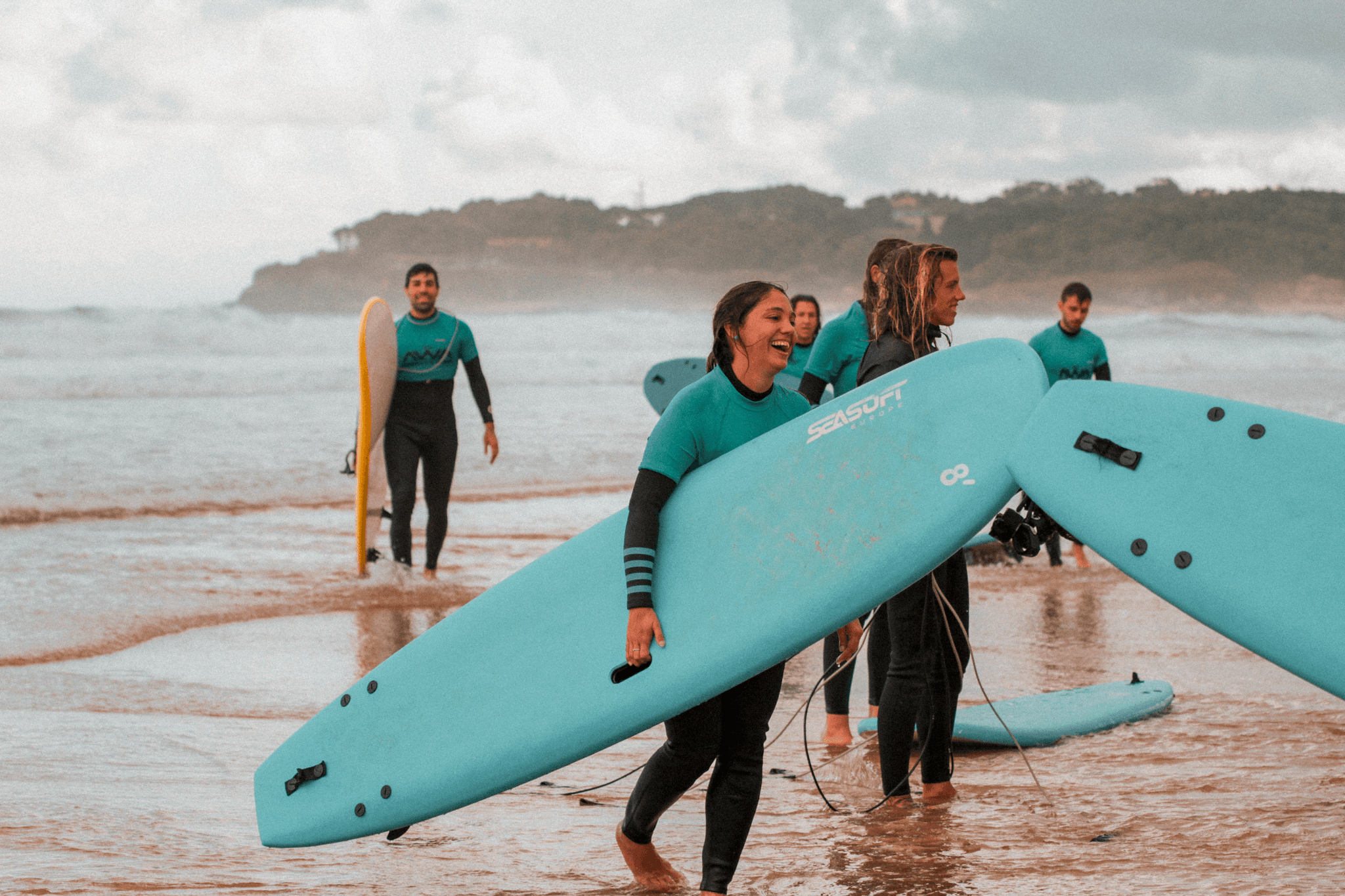
The softboard — or foam board — is the soft-deck board you see at surf schools around the world. A lot of people write it off as a toy for kids or the first couple of days in the water. That's a mistake.
The softboard is the most effective tool for learning to surf, regardless of age. The soft deck reduces the risk of injury when you fall, the high volume delivers stability and easy paddling, and the width lets you pop up without fighting for balance on a narrow surface. It lets you focus on technique instead of survival.
Most surfhouses on Surfhouse.world include softboards in their on-site rental. If you're planning your first surf trip, don't buy anything before you've spent at least a week in the water on a quality foam board.
When it makes sense to stick with one: longer than you'd think. Plenty of intermediate surfers go back to the softboard in small-wave sessions precisely because the extra volume means more waves caught, more reps on technique, and more fun. It's not a step backwards — it's smart surfing.
Funboard and mini-malibu: the bridge between foam and performance
The funboard and mini-malibu occupy a specific place in the progression journey: boards with enough volume for surfers still developing their skills, but with a shape that starts to move toward performance territory.
The key difference from a softboard is the material — fibreglass or epoxy — and the more tapered outline, which responds better to your movements and lets you begin working on the building blocks of real manoeuvres. These aren't high-performance boards, but they're a genuine step forward without giving up the buoyancy you still need when your level isn't fully locked in.
Who they're right for: surfers who've found a stable stance on the board, are catching waves with reasonable consistency, and want to start working on their first basic manoeuvres. Typically after the first or second week of intensive surfing, or after a second surf trip.
How they perform in the water: they work well in small, soft waves — the kind you get in summer or at sheltered destinations. They lose their edge in more powerful, hollow surf, where the volume becomes a limitation rather than an asset.
Longboard: a surf style all its own
The longboard is a category unto itself. It's not a board for surfers who can't yet handle a shortboard — it's a style of surfing with its own philosophy, its own aesthetic, and a technique that takes years to truly master.
The defining features are the length — typically between 9 and 10 feet — high volume, a rounded nose, and either a single centre fin or a 2+1 setup. That combination produces a board that glides onto the tiniest waves, flows through slow, graceful manoeuvres like noserides and cross-steps, and delivers a completely different experience in the water from modern surfing.
Who it's right for: anyone who loves small, slow waves; anyone who prefers a fluid, contemplative approach over the aggression of modern surfing; anyone who wants to surf in conditions where a shortboard would be pointless. This isn't a compromise — it's a deliberate choice of style.
How it performs in the water: exceptional on small, slow, well-shaped waves. It loses manoeuvrability on steep, powerful surf, where the length becomes a real limitation. Ideal longboard destinations are those with long, mellow swell: certain spots along the Portuguese coast, the bay of Imsouane in Morocco, and the slower waves at some of the Canary Islands' beaches.
Fish: volume and speed in small surf
The fish is a short, wide board with a swallow tail that was born in the seventies and has never gone out of relevance. Its defining trait is the balance between reduced length and high volume: it gives you the responsiveness of a short board with significantly more buoyancy than a standard shortboard.
Who it's right for: intermediate and advanced surfers who regularly ride small, slow waves where a shortboard struggles to plane and generate speed. The fish is the call on those days when the surf simply doesn't have the punch to make a performance board work.
How it performs in the water: blindingly fast in flat, slow surf, turning mediocre conditions into genuinely fun sessions. Less precise on vertical manoeuvres than a shortboard — it's not the board for working on snaps and airs — but when the waves are under a metre, it's hard to beat for sheer fun.
Destinations where it shines: the summer waves of the Canary Islands, certain spots along the Portuguese Algarve, and the slow beach break of Conil de la Frontera on the Andalusian coast.
Shortboard: the performance board par excellence
The shortboard is the board you see in every professional contest and the one most surfers dream of riding before they've actually got the level to do it justice. Between 5'8'' and 6'4'', low volume, pronounced rocker, three or five fins: it's built for high-performance surfing on quality waves.
The most common mistake: making the jump too soon. A shortboard with insufficient volume for your level will slow your progression rather than accelerate it. If you're struggling to catch waves, if paddling leaves you gassed, if sets are rolling through while you're still trying to get into position — the volume is probably too low for where you are right now.
Who it's right for: advanced surfers with solid, established technique — surfers who can generate their own speed on a wave, execute clean bottom turns, and read the wave well ahead of time. Realistically, the minimum level to actually get something out of a shortboard is someone who's been surfing regularly for at least two or three years on quality waves.
How it performs in the water: exceptional on powerful, hollow waves with a clean face. It loses a lot in small, slow surf, where the low volume makes planing a struggle. The destinations where it truly delivers are those with consistent swell: Morocco in autumn and winter, Portugal from September to November, Jeffrey's Bay in South Africa, the Mentawai Islands in Indonesia.
Choosing based on your destination and the spots
Board choice isn't just about your level — it's also about where you're going and what the waves will be like. A practical breakdown to help you navigate it.
Small, slow waves — summer or sheltered destinations (Canary Islands in summer, Conil de la Frontera, sheltered beaches in Portugal): fish or funboard for intermediates, longboard for those drawn to classic style, softboard for beginners. The shortboard will struggle in these conditions.
Medium, consistent waves — Atlantic autumn (Portugal, Morocco, Canary Islands in autumn): the most versatile range. A well-volumed shortboard for advanced surfers, a mini-malibu or mid-length for intermediates, a funboard for those still building their foundation.
Solid, powerful waves — winter (advanced Morocco, Jeffrey's Bay, Mentawai, Indonesia): shortboard if your level is there — nothing less. In surf this powerful and precise, boards with too much volume become hard to control and less safe when things go wrong.
Tropical destinations with warm-water waves (Sri Lanka, Nicaragua, Brazil, Bali): it depends on the spot. Ahangama and Mirissa in Sri Lanka offer accessible waves where a mid-length or funboard works well. The Mentawai and the reef breaks of Bali call for a performance shortboard.
The most common mistake in equipment progression
It's worth saying plainly: progression through boards isn't linear, and it shouldn't be forced.
The typical path runs from softboard to funboard or mini-malibu, then mid-length or fish, then shortboard. But how quickly you move through it depends entirely on the time you put in the water and the quality of your sessions — not how many years you've been surfing or how many boards you've bought.
Many surfers rush the process out of ego or peer pressure and end up on a shortboard with the wrong volume, where improvement stalls. Others stay on a comfortable board for too long and never push beyond their comfort zone.
The most honest gauge for knowing when it's time to move on is this: if you're getting 90 percent out of what your current board can offer, it's time to take the next step. If you're still well short of that ceiling, switching boards won't make you progress any faster.
FAQ
Other articles
Winter Surfing: the Best Destinations (and How to Pick the Right One)
The best winter surf destinations: Canary Islands (consistent waves, short flight), Sri Lanka (December–March, all levels), Indonesia (Mentawai and Bali, advanced surfers), South Africa (Jeffrey's Bay, iconic breaks), and Nicaragua (Popoyo, uncrowded lineups)
Autumn Surfing: Where to Go (and Why It's the Best Season of All)
Autumn surfing at its finest: Morocco, Portugal, the Canaries, and Northern Spain peak between September and November. Fewer crowds, better prices, and Atlantic swells that leave summer in the dust.
Surf This Summer: The Beginner's Guide to Getting Started (and Getting It Right)
Summer surf for beginners: top destinations include the Canaries (Las Palmas, Lajares, Adeje), Northern Portugal (Figueira da Foz, Estela Porto), France (Vieux Boucau), and Australia (Arrawarra NSW, austral winter).
DIY surf trip: the practical guide to planning it efficiently
A DIY surf trip comes together in five steps: pick the right destination for the season and your level, book your flight 6–10 weeks out, find a verified surfhouse close to the breaks, sort your gear before you leave, and read the forecasts on Windguru or Surf-Forecast