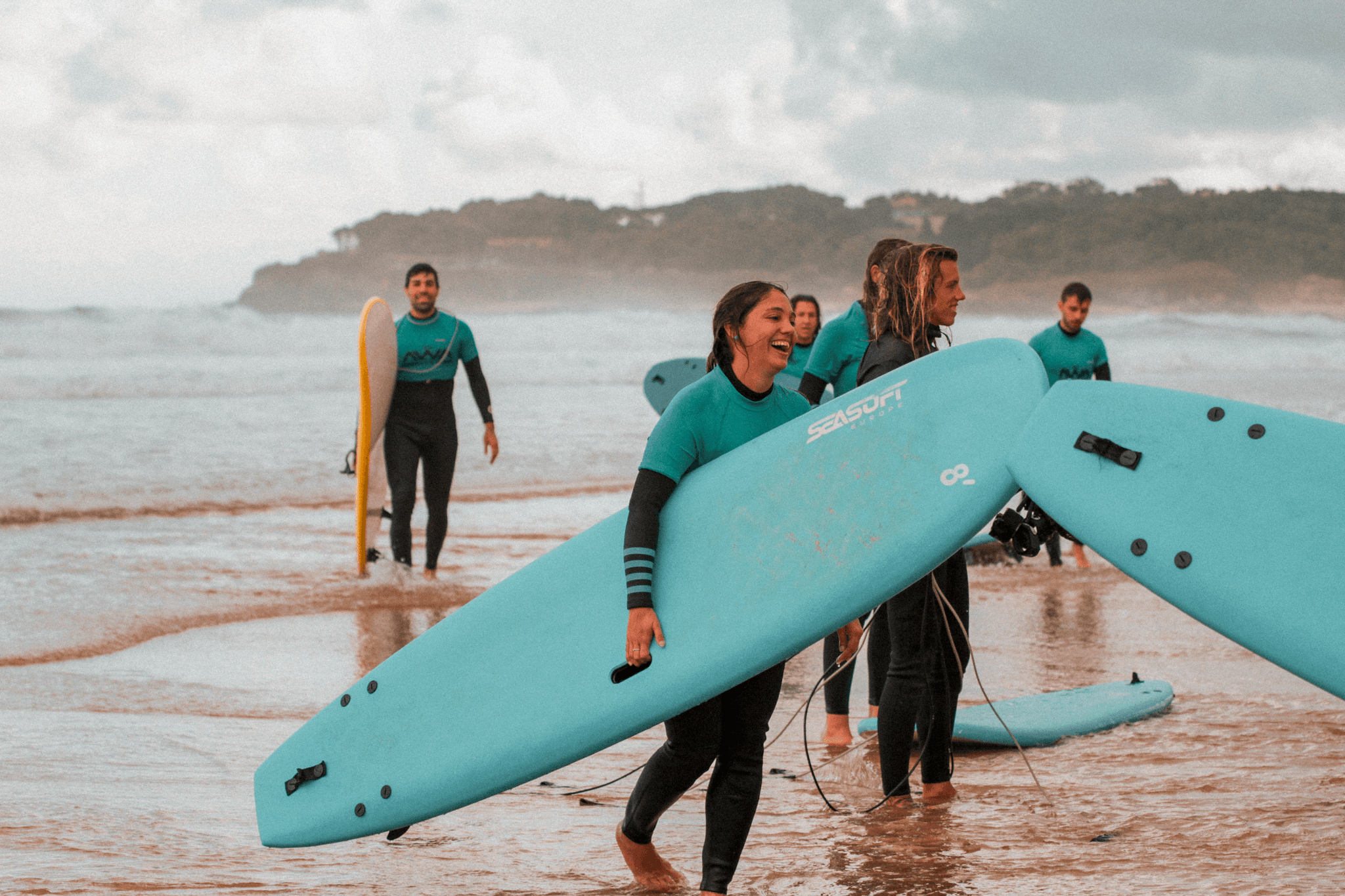
Surf workations work because surfing imposes a natural structure on your day that drives focus during work blocks. The best destinations combine reliable connectivity, a time zone compatible with European clients, and waves accessible to beginners. Bali, Portugal, the Canaries, and Morocco are the strongest starting points. On Surfhouse.world you'll find handpicked properties across all of these destinations.
Surf workation: how it works, where to go, and why it actually works
There's a version of remote work that nobody brings up on video calls. Not the beach-office fantasy with a laptop on a towel — that's uncomfortable and unworkable. It's something far more grounded: a routine built around the tides, with work hours concentrated in the early morning or late afternoon, and surf sessions filling the blocks in between.
This isn't a holiday with a laptop in your bag. It's a different way of structuring work that, for many digital nomads, turns out to be more productive than any fixed desk in any office.
This article explains why surf and remote work pair better than you might expect, which destinations genuinely work for this format, and what to look for in a surfhouse when your goal isn't just to surf — but to work well too.
Why surf and remote work go so well together
The answer isn't romantic — it's structural.
Remote workers without external structure tend to have shapeless days. Trouble switching off, trouble focusing, a blurred line between work time and free time. It's one of the most common struggles among digital nomads, and no productivity app really fixes it.
Surfing introduces a structure you don't have to build yourself: the best waves come at specific times, dictated by the tides and the wind. In most Atlantic destinations, the best conditions arrive in the early morning, before the offshore breeze gives way to the afternoon onshore. That means surfers tend to wake up early, get in the water, come back for breakfast, and sit down at their desk with their mind already sharp and their body already awake.
For many people, the result is a morning work block of far higher quality than anything they'd manage in an office. Salt water, physical effort, and the focus that surfing demands produce a mental state that translates directly into concentration. It's not a placebo — it's physiology.
The key is how you structure your day. A surf workation that actually works isn't a holiday with a few hours of work squeezed in. It's a routine with set hours, clear daily goals, and the discipline to respect your work blocks even when the waves look perfect outside the window.
You don't need to know how to surf to get started
This is the most common misconception among digital nomads considering a surf workation for the first time.
There's no minimum skill level required to make this format work. All you need is the curiosity to try and the willingness to learn — which is exactly the same mindset that leads people to work from a different place every month.
The surfhouses best suited to workations for beginners are those in destinations with small, consistent waves, on-site instructors, and a guest community with a healthy mix of levels. You won't be the only beginner in a lineup of pros — surfhouses attract people at every stage of the journey, and learning in a mixed social environment is often the most effective experience of all.
The surf learning curve is steep in the first few days and then levels off. After a week of daily sessions with an instructor, most people can get to their feet with some consistency. That's not the finish line, but it's enough to know whether surfing is for you. And in most cases, it is.
How to structure your day on a surf workation
The format that works best — tested by people combining surf and remote work for years — revolves around three blocks.
Morning block: surf. Early wake-up, session in the water during the best conditions of the day. Typically from 7 to 9 or 10 in the morning in Atlantic destinations, slightly different in tropical locations where the light comes sooner and the heat hasn't turned oppressive yet. Breakfast after the session.
Middle block: work. The longest and most productive work block, generally from 10 to 14:00 or 15:00. The physical tiredness after surfing actually sharpens focus: your body is activated, your mind is alert but calm. This is the time for deep work — not emails and calls.
Afternoon block: flexible. A second surf session if conditions allow, or lighter work, team calls, and activities out of the water. In destinations where afternoon wind makes the sea less surfable, this block naturally becomes time for work or local exploration.
This structure isn't rigid and shifts depending on the destination's time zone and your clients' or team's schedules. But the logic is always the same: surfing doesn't take time away from work — it structures it.
The best destinations for a surf workation
Not every surf destination works equally well for remote workers. Beyond wave quality, three variables matter most: internet connectivity, time zone compatibility with Europe, and a community of like-minded people:
Bali (Canggu and Denpasar)
Bali is the definitive workation destination — and for good reason. Canggu in particular has built one of the most complete digital nomad infrastructures in the world over the past few years: coworking spaces everywhere, reliable connectivity, a dense and active international community, and surf accessible to all levels along the coast.
The time zone is the main hurdle for those working with European clients: WITA (Bali Time) runs seven hours ahead of Central Europe. That means European meetings land in the late afternoon or evening local time, freeing up the core hours of the day for async work and surf. For async workers, it's actually an advantage. For those with lots of live calls with Europe, it takes some adjusting.
The waves at Canggu are beginner-friendly: beach break with waves between 0.5 and 1.5 metres on most days, instructors on hand, and surfhouses with everything a first-timer needs.
Find handpicked surfhouses in Bali on Surfhouse.world
Portugal (Lisbon, Costa da Caparica, Colares)
Portugal is the most natural choice for European digital nomads who want a surf workation without changing time zones. Lisbon and its surroundings have a well-established coworking ecosystem, reliable internet, and a fast-growing digital nomad scene.
Costa da Caparica, half an hour from Lisbon, is one of Europe's most beginner-friendly beach breaks: consistent waves, sandy bottoms, surf schools on tap. Colares, in the Sintra area, adds a unique natural backdrop with a quieter atmosphere than the busier stretches of coastline.
The logistical advantage is hard to beat: same time zone as Central Europe in winter, one hour's difference in summer. Zero jet lag, easy to get back if needed, and daily direct flights from Italy.
Find handpicked surfhouses in Portugal on Surfhouse.world
Canary Islands (Las Palmas, Fuerteventura, Lanzarote)
The Canaries are the answer for anyone who wants a surf workation without giving up guaranteed sunshine. Las Palmas de Gran Canaria in particular is one of the European cities with the highest concentration of digital nomads: quality coworking, a lively international community, the same time zone as Europe in winter and one hour behind in summer.
The urban break at Las Palmas works on almost any day of the year with waves suitable for beginners. Fuerteventura and Lanzarote add more varied spots for those who progress quickly and want to explore different conditions over a stay of several weeks.
Find handpicked surfhouses in the Canary Islands on Surfhouse.world
Morocco (Tamraght, Aourir)
Morocco is the choice for those who want a surf workation with a very low cost of living and a genuine cultural immersion. The Tamraght and Aourir area has developed a solid infrastructure for surfers and slow travellers over the past few years, including decent connectivity, surfhouses with shared communal spaces, and waves accessible to all levels.
The time zone is ideal for European freelancers: Morocco runs on the same time as Central Europe in winter, with zero offset. The monthly cost of a full-board surfhouse in this area is among the lowest across the entire network.
Spring and autumn are the best seasons for this format: comfortable temperatures out of the water, consistent but manageable waves, and far fewer tourists than the summer months.
Find handpicked surfhouses in Morocco on Surfhouse.world
What to look for in a surfhouse for a workation
When you're looking for a surfhouse for a workation, the questions you need to ask are very different from those you'd ask for a week's holiday.
Connectivity. The first thing to check, every time. Not all surfhouses have internet built for work — some have connections designed for evening streaming, not video calls. Before you book, check whether the listing specifies connection speed, or reach out to the property directly.
Workspace. A decent desk, a chair with proper back support, and a reachable power socket aren't luxuries — they're the bare minimum for working well. Surfhouses designed for longer stays tend to have communal spaces properly set up for this.
Minimum stay. A surf workation makes sense from two weeks upwards. Below that threshold you don't have enough time to build a routine, learn the basics of surfing, and find your rhythm between work and water. Some surfhouses on Surfhouse.world offer weekly or monthly rates that make longer stays genuinely cost-effective.
Community. A surfhouse with other digital nomads or long-term travellers creates a very different environment from one that mainly hosts passing tourists. The social dynamics of a surfhouse with a stable guest base start to resemble those of a coliving: you share sessions, eat together, work in the same space. For many people, that's exactly what they're looking for.
On Surfhouse.world you can filter by destination and travel dates to find the properties best suited to a longer stay.